
At many commercial facilities, parking is still run with barrier cards, a cash register and a handwritten logbook. This setup causes no problems at a small site; but as vehicle numbers grow, staff turn over or multiple shifts come into play, the cracks start to show: at the end of the day the cash in the register does not match the report, nobody is at the entrance gate when a staff member is on leave, and working out after the fact which vehicle stayed how long takes hours.
This guide does not explain what a parking management system is. For that definition, see our parking management system guide. The focus here is how a facility that still runs manually or semi-manually should decide to move to automation, how to calculate the return on the investment and how to manage the transition.
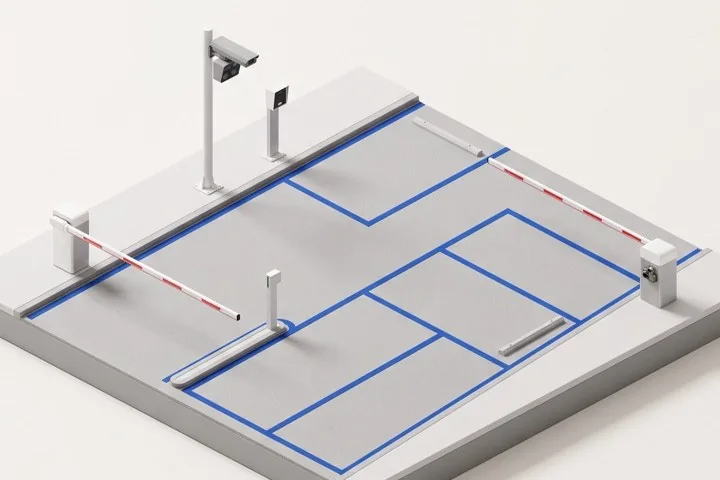
Signs That It's Time to Move to Automation
The decision to move to automation usually comes up not because of a single event but because small problems pile up on top of each other. If you are seeing several of the following signs at the same time, your facility has probably reached the limits of manual operation:
- The cash doesn't match the report. At the end of the day there is regularly a gap between the cash collected and the expected revenue, and the cause cannot be identified.
- Dependence on staff is high. When the shift supervisor is on leave or sick, entry/exit control falters or stops entirely.
- Capacity can no longer be managed with barrier cards. As vehicle numbers grow, the entry queue gets longer and cards are lost or copied.
- There is no historical data. It is impossible to show retrospectively when a particular vehicle entered and left, or which staff member made which collection.
- There is a growth plan. If a second facility will open or the capacity of the existing facility will increase, the manual process will create an exponentially growing burden at the second location.
How Is the Return on Investment Calculated?
The most frequently asked question about moving to automation is this: how many months will it take for the investment to pay for itself? The honest answer is that there is no single number. The payback period varies with the facility's vehicle volume, its current leakage rate (collections that go unrecorded) and the size of the investment.
An industry analysis published by Parking BOXX, a North America-based parking automation vendor, reports that facilities moving from manual to automated operations see revenue increases in the 15–30% range, and that in sample scenarios the investment pays for itself in under two years. A caveat is needed when reading this: it is not independent academic research but an observation published by a vendor that sells automation solutions; actual results vary from facility to facility, and you need to run your own calculation with your own site data.
The revenue increase range reported by Parking BOXX for facilities moving from manual to automated operations (vendor-sourced, not independently verified).
A sample calculation can be set up as follows. The figures below are entirely illustrative; they are not data from any real facility and are intended only to show how the calculation is structured. Assume a facility that collects TRY 3 million in cash revenue per year can recover 15% of its leakage (TRY 450,000) through automation, and that shifting some of the cashier staff to system monitoring duties saves TRY 150,000 per year in staff costs. With an annual net benefit of TRY 600,000 against an installation investment of TRY 900,000, the payback period is roughly a year and a half.
Source: Parking BOXX, "How to Calculate the ROI of Parking Automation" (vendor publication, not independent research). The TRY figures in the chart are an illustrative example based on the calculation logic in the source; they do not reflect the financial data of any real facility.
What Stages Does the Transition Go Through?
Moving to automation is not simply a matter of swapping barriers overnight. Proceeding in stages makes it easier both to catch errors early and to help staff adapt to the new system.
Before and After Automation: What Changes?
The table below summarizes what typically changes at a facility that moves from manual operation to automation. This is not a list of promises but the direction of change commonly observed in the industry; it may not happen to the same degree at every facility.
| Area | Manual Operation | After Automation |
|---|---|---|
| Cash collection control | Manual count at end of day; discrepancies hard to detect | Every transaction recorded in the system; instant reconciliation possible |
| Dependence on staff | Entry/exit falters without the shift supervisor | Entry/exit continues as long as the system is running |
| Reporting speed | A report request can take days | Occupancy and revenue reports are available instantly |
| Capacity management | Queues grow as vehicle numbers increase | Throughput stays constant; queues don't grow |
| Dispute resolution | No proof when a customer says "I already paid" | Time-stamped records resolve disputes quickly |
Common Mistakes During the Transition
Most automation projects run into trouble for process-related rather than technical reasons. The most common mistakes are:
A big-bang transition. Changing all entrances and all shifts at once means any disruption affects the entire facility. Skipping the pilot stage also removes the chance to catch errors early.
Leaving staff untrained. Even if the system is installed flawlessly from a technical standpoint, if on-site staff don't know how to handle exceptions (a faulty card, a disputed transaction), day-to-day operations start working around the system.
Incompatibility with existing infrastructure. Starting installation without first integrating old barrier motors or inadequate electrical wiring with the new system leads to unexpected delays on site.
Vendor lock-in. An installation in which data and hardware only work within a single vendor's closed system can make switching vendors later almost impossible. Data portability should be clarified before signing the contract.
Overlooking KVKK obligations. License plates and entry/exit records count as personal data under KVKK (Turkish Personal Data Protection Law No. 6698); retention periods and access permissions should be planned from the outset as part of the automation installation.
How Should You Budget the Cost Items?
The cost of the transition is not just the price of cameras and barriers. Items that don't appear on the quote, such as concrete cutting and cable pulling, electrical infrastructure, software licenses and staff training, significantly affect the total budget. You can find the full list of these items and their typical budget shares in the "hidden cost items" section of our smart parking system guide; rather than repeating them here, we point you directly to that resource.
Which Facility Types Should Prioritize It?
Moving to automation is not equally urgent at every facility. At industrial sites, separating staff and supplier vehicles with a manual schedule becomes increasingly difficult; at shopping malls and mixed-use projects, heavy visitor traffic can no longer be managed with barrier cards; and at business centers, handling the distinction between subscribers and guests by hand consumes more staff time every day. These three profiles are among the facility types where the return on moving to automation is seen fastest.
Conclusion
Moving a manually operated parking facility to automation is not a single hardware purchase but a process that starts with an analysis of the current state and extends from a pilot implementation to a full rollout. The return on investment varies from facility to facility; so rather than relying on general industry figures, running a calculation based on your own leakage rate and vehicle volume is the most reliable way to make the right decision.
You can start by comparing the list of signs in this guide with your own facility, and then request a site-specific survey.
Frequently Asked Questions
When should a parking facility move to automation?
Frequent discrepancies between cash collections and the revenue report, end-of-day closing still being done by hand, entry/exit faltering when staff are on leave, and vehicle traffic that can no longer be managed by handing out barrier cards are the main signs that it is time to put automation on the agenda.
What is the payback period for moving to automation?
There is no fixed period; it varies with the facility's vehicle volume, current leakage rate and the size of the investment. According to an industry analysis published by a North America-based parking automation vendor, facilities moving from manual to automated operations have reported revenue increases in the 15–30% range and, in sample scenarios, payback periods of under two years; this is a vendor-sourced observation rather than independent research, and the calculation for your own facility should be based on your site data.
Are existing staff laid off when moving to automation?
Generally not; experience points to a change in job descriptions rather than staff being eliminated entirely. Staff who collect payments at the cash desk can move to roles such as system monitoring, exception handling and on-site supervision. This is a business decision that depends on the scale of the facility and the scope of the automation.
Can existing barrier and camera infrastructure be kept when moving to automation?
Often, yes. Depending on the manufacturer and age, existing barrier motors and camera hardware can be integrated with new software and a new control unit; in that case the investment remains lower than a from-scratch installation. Whether integration is possible is determined by a site-specific technical survey.
Are parking automation and a parking management system the same thing?
Yes, technically they refer to the same category; the real difference lies in marketing language, which varies from vendor to vendor. Rather than defining an existing parking management system, this guide focuses on the process of moving a manually operated facility to automation.
How is a pilot implementation carried out when moving to automation?
Instead of changing all entrances at once, a limited pilot is launched at a single entrance or on a single shift. During the pilot, the old and new processes are monitored side by side, deviations are corrected and staff get used to the new system; once it is shown to run smoothly, it is extended to the rest of the facility.
How does Park Expert support the transition to automation?
Park Expert starts with a site survey, assesses whether the existing infrastructure is suitable for integration, runs the pilot implementation together with you and provides technical support through to full rollout. To see how the process would work for you, you can fill out the quote form or request a demo of the Park Expert License Plate Recognition System.